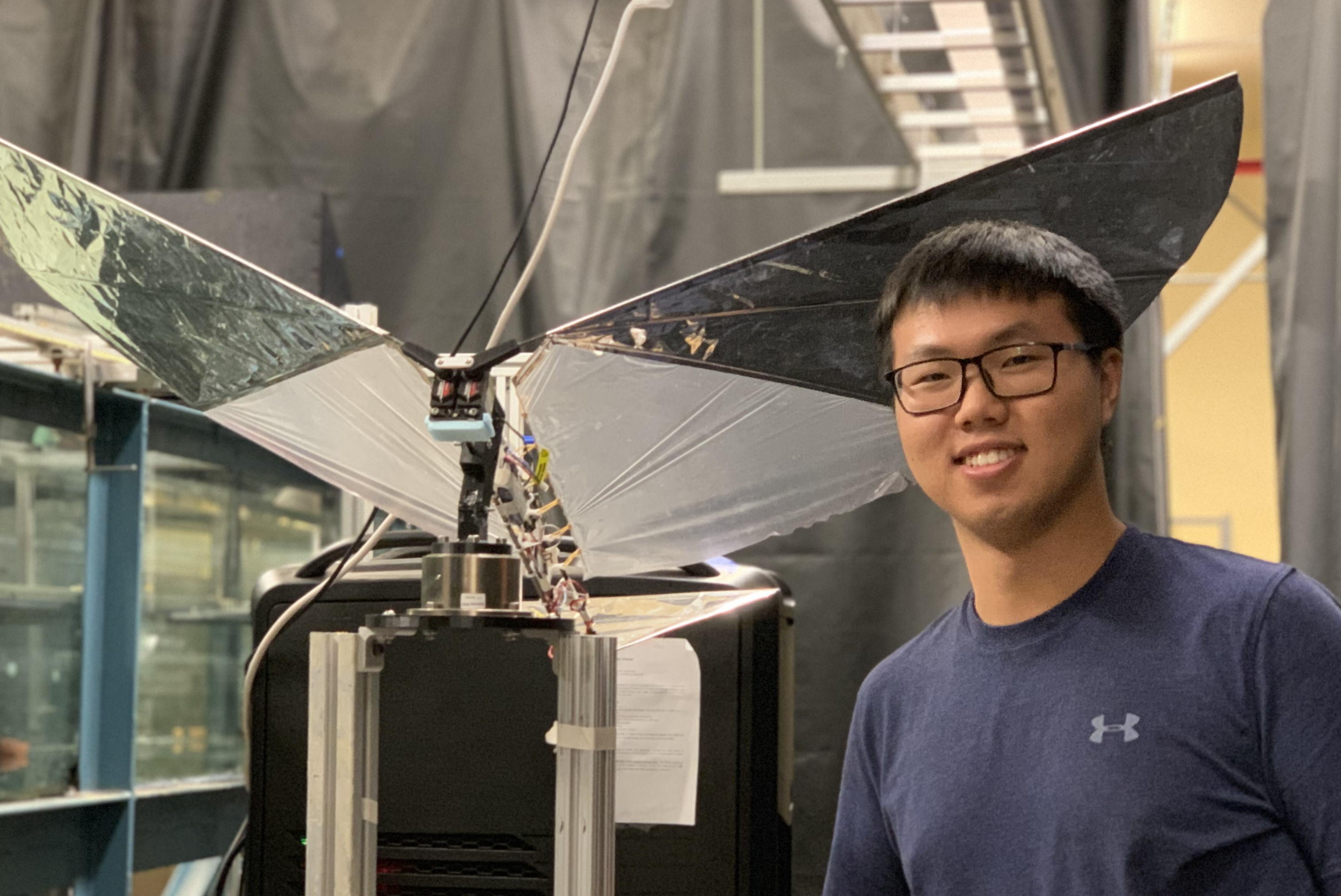
Surfing Wing: Aerodynamic Forces in a Two-Dimensional Vortex Wake
If a flapping flyer gains something from another’s wake, the effect should be measurable on a rigid wing too — without the confounding variability of a live animal. This project is the engineering counterpart to the Surfing on Vortices bird experiments.
A servo-driven wake generator pitches a flat plate sinusoidally upstream; a NACA 0012 wing mounted 350 mm downstream on a six-axis load cell measures forces at 5 kHz over 100 cycles, while 2D2C PIV captures the vortex dynamics in the same plane. The whole setup is automated in MATLAB with synchronized acquisition, which is what makes a sweep across Strouhal number, reduced frequency and flapping amplitude tractable.
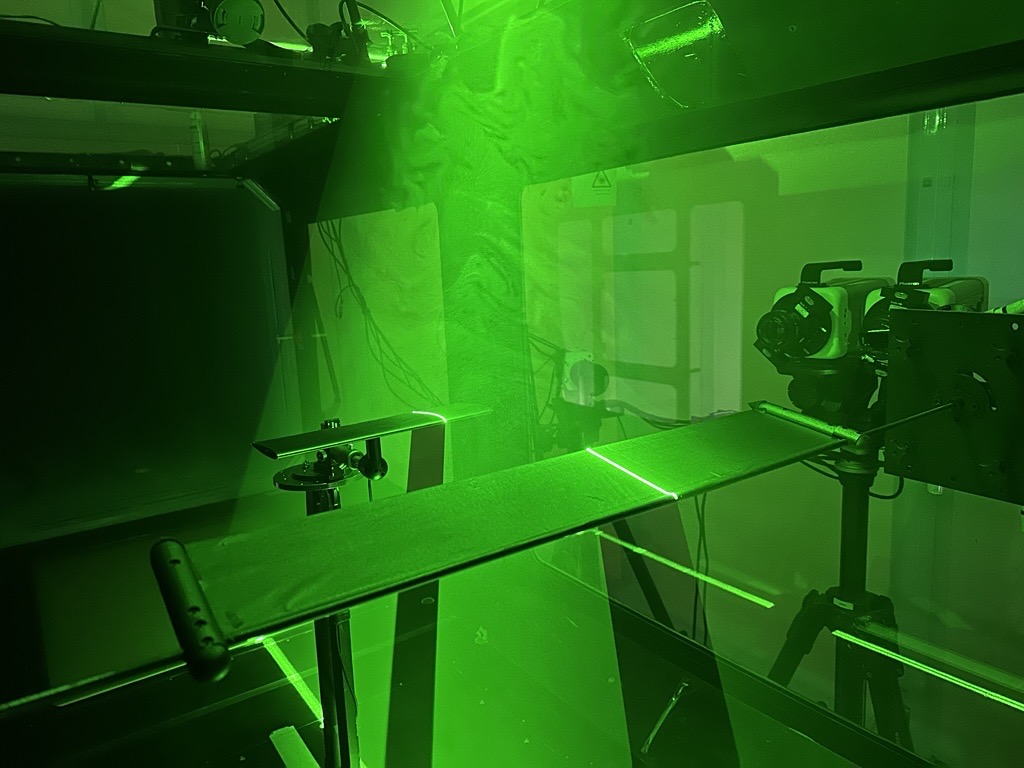
Two results drive the work:
- The wing’s lift response locks to the wake-generating frequency, and cycle-level lift fluctuations scale with Strouhal number — 58–99% of the spectral energy sits in the primary peak.
- Classical unsteady aerodynamics predicts the phase-resolved lift well when the right tool is used: Wagner’s function with Duhamel’s integral tracks the measured lift closely, while a quasi-steady approach massively over-predicts it.
Presented at the 77th APS-DFD Annual Meeting (2024); manuscript under review at the Journal of Fluid Mechanics.