Surfing on Vortices: Bird Flight in a Structured Vortex Wake
Birds rarely fly in still air. This project, carried out in the Breuer Lab at Brown University, asks what a flapping flyer does when it meets a structured vortex wake — and whether it can extract energy from one.
A two-dimensional wing pitching upstream of the test section generates a repeatable vortex street inside Brown’s animal flight wind tunnel. European Starlings then fly through it at 11 m/s, between the wake generator and a downstream machine-vision camera array.
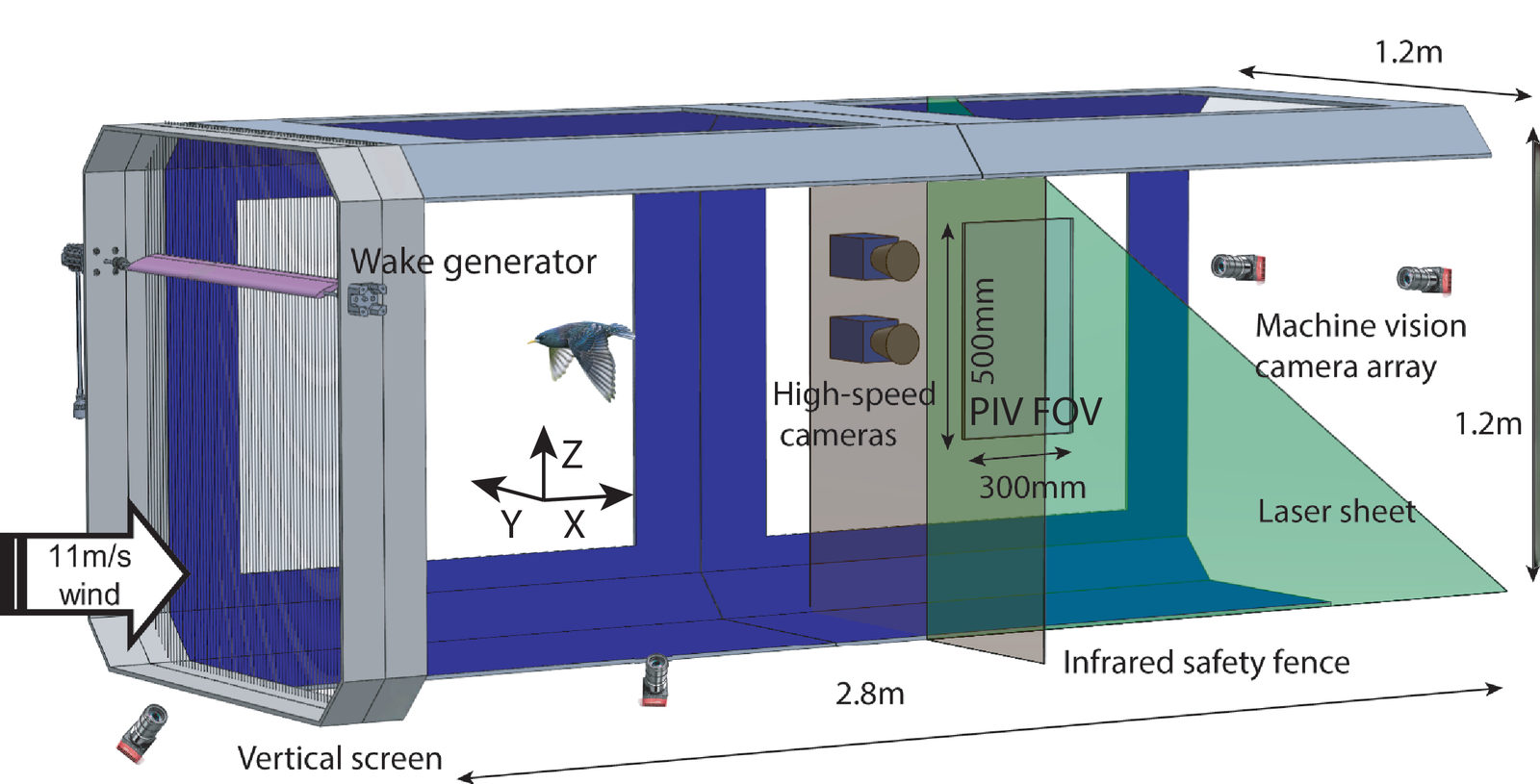
Four measurements run simultaneously:
- machine-vision kinematic tracking of body and wing motion (3D reconstruction via DLT)
- planar particle image velocimetry (PIV) of the surrounding flow
- body dynamics from a bird-wearable inertial device
- metabolic cost via the 13C-labelled sodium bicarbonate method
Commissioning the newly built wind tunnel — hardware, control software and synchronized multi-channel acquisition — was a substantial part of the work, as was leading a 10-member engineering team and collaborating with biologists at UMass Amherst and UNC Chapel Hill.
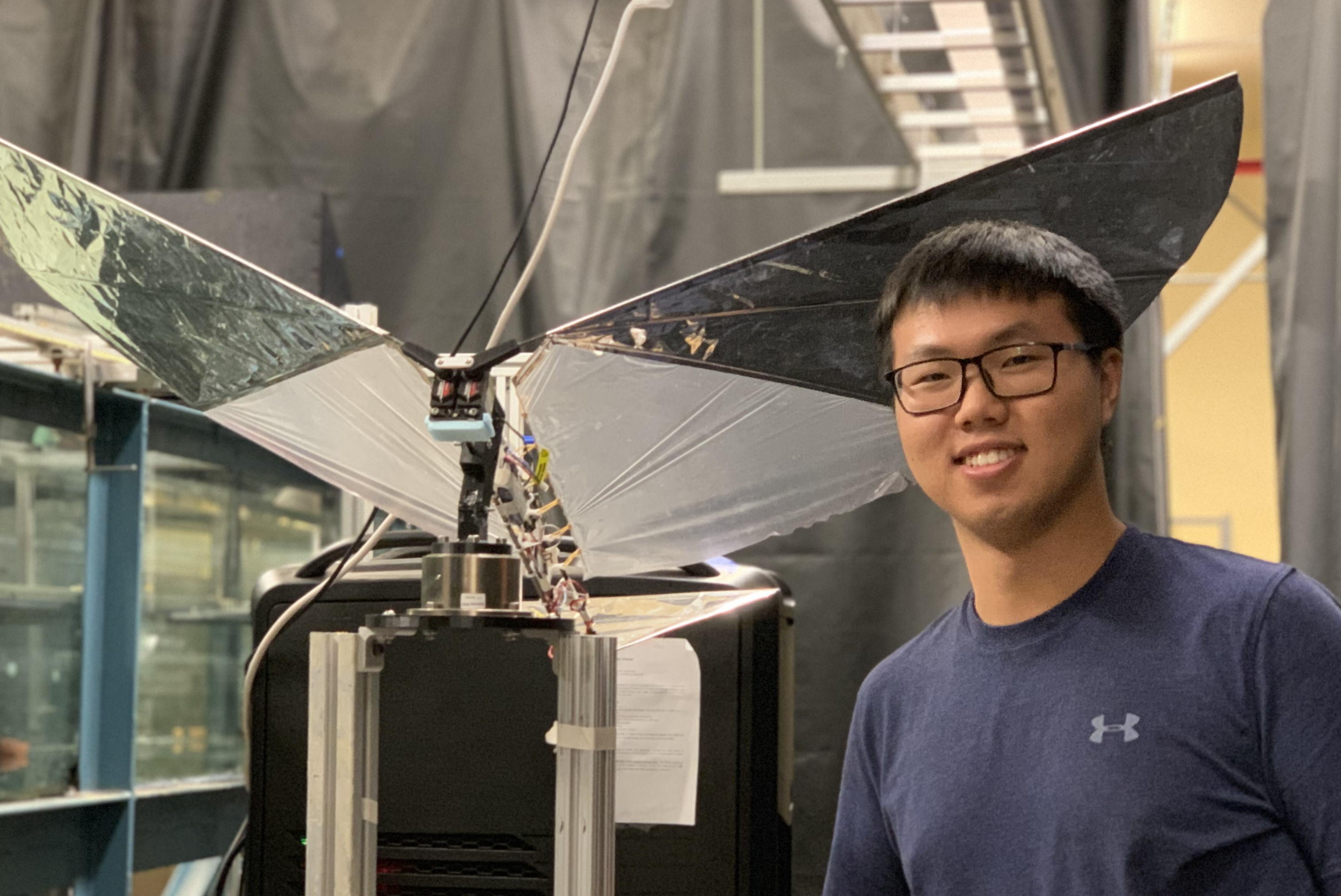
The results speak to a practical problem: how UAVs and wind turbines respond to vortex gust encounters, and how flocking birds may gain energetic benefit from each other’s wakes. The companion Surfing Wing study isolates the same aerodynamics on a rigid, instrumented airfoil.
Publications from this work:
- S. Hao, N. Medina, M. Islam, R. Gissler, T. Hedrick, A. Gerson, K. Breuer, Surfing on vortices: bird flight responses to an unsteady vortex wake, Experiments in Fluids 67, 162 (2026) — open access
- T. L. Hedrick, S. I. Friman, C. R. Elowe, S. Hao, A. R. Gerson, K. S. Breuer, Flapping frequency, amplitude, and organization: associations between accelerometer data and flight energy costs during solo and small group flight of European Starlings, Integrative and Comparative Biology 66, icag124 (2026)
- S. I. Friman, C. R. Elowe, S. Hao, et al., It pays to follow the leader: Metabolic cost of flight is lower for trailing birds in small groups, Proceedings of the National Academy of Sciences 121(26), e2319971121 (2024)