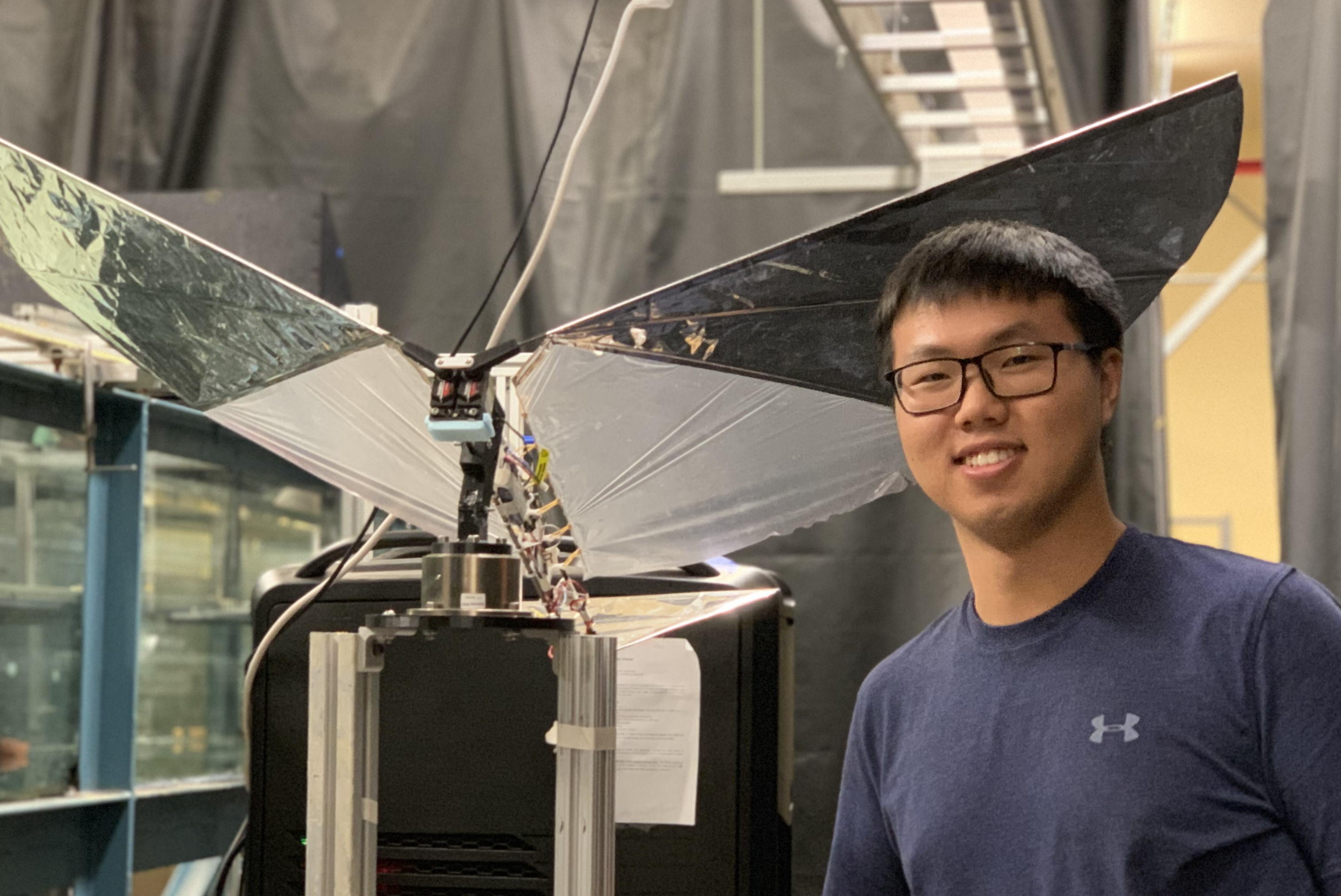
Hydrodynamics of Robotic Fish Schooling
At the University of Virginia, as part of the ONR Multidisciplinary University Research Initiative (MURI) program, this project asks when swimming together actually pays off. Using pairs and small groups of robotic swimmers, we measure how the phase difference between neighbouring flappers — and the geometry of the formation — changes the thrust, power and efficiency of each individual.
The experiments run in a closed-loop water tunnel facility built around an automated, cyber-physical workflow: motion control, force sensing and flow measurement are synchronized and script-driven, so large parameter sweeps can be collected and processed without manual intervention.
Related work on formation geometry and group swimming efficiency was carried out as a Visiting Scientist at the University of California, Riverside.